‘Teenage Sex and Death at Camp Miasma’ Review: A Modern Meta-Slasher Masterpiece
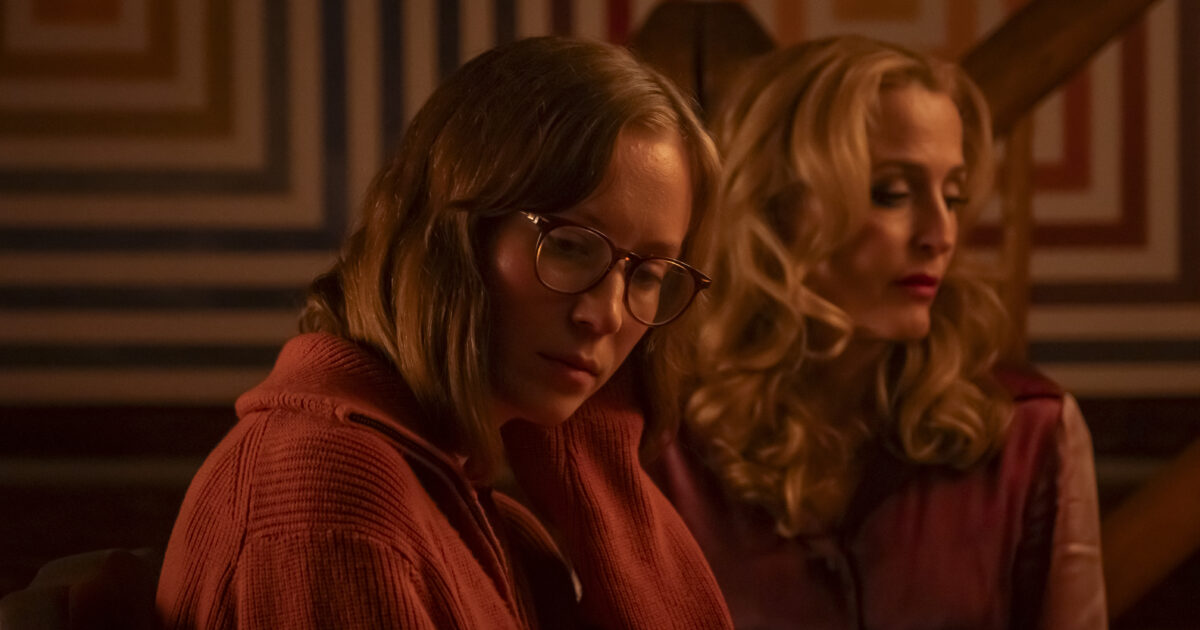
It’s all in the title, really. Teenage Sex and Death at Camp Miasma is about exactly what its title suggests. The film follows neurotic queer filmmaker Kris (Hannah Einbinder, fantastic in her first leading film role), who’s been tasked with rebooting the titular 80s slasher series. So, she sets out to bring the series’ original Final Girl-turned-recluse, Billy Presley (played wonderfully by Gillian Anderson), on board. When the two meet, they become entangled ways neither could predict.
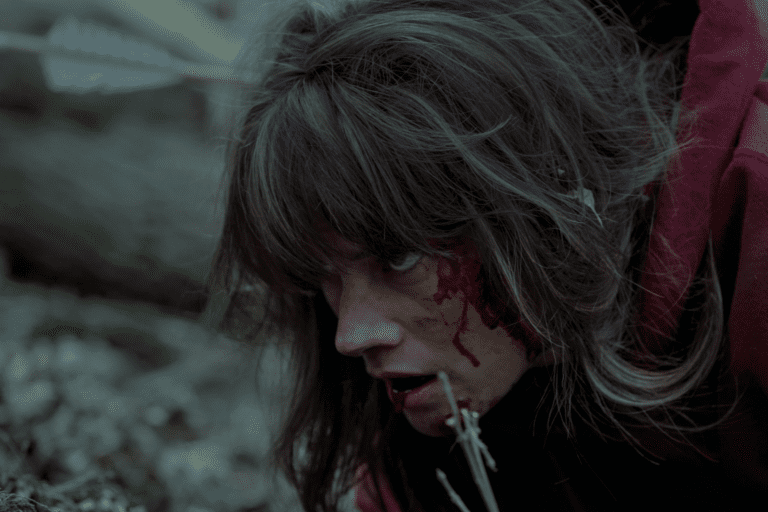
Think of the fictional movie-within-a-movie ‘Camp Miasma’ as a kind of lovechild of Friday the 13th and Sleepaway Camp, and you’ll understand that teens having sex and dying comes with the territory.
On another level, the title also signals the way the movie is concerned with the (typically) teenage experience of self-discovery, of coming into your own body and identity.
At one point in the movie, Kris tries to explain to Billy why she’s so obsessed with the series and how she intends to make it her own. She intellectualizes it, invoking Judith Butler. Billy stops her. The series was never about all that. It was about “flesh and fluid,” she says.
Kris, uncomfortable in her own skin and sexuality, of course doesn’t quite get that, even if she wants to. She’s fixated on one pivotal moment in the original film—a look in Billy’s eye during her climactic orgasm/death scene. She can’t quite articulate what it is that she sees in Billy’s eye. But she wants it. She wants it so badly.
It’s this tension between the brain and the body that underscores a lot of the film.
Schoenbrun has said that the film is “essentially a movie about learning to enjoy sex after transition.” When you’re “in the wrong body,” pleasure in sex is out of reach, leading to dissociation.
The film’s depiction of sexual dissociation—and of learning how to enjoy that kind of intimacy with someone who cracks you open and makes you feel safe and seen—is its beautiful, emotional core. It’s maybe the first time I’ve ever seen that particular kind of relationship to sex put to screen—and if not, it’s certainly the most moving.
Part of that repressed sexuality, as in TV Glow, comes from the way these characters use media as a way to escape their present reality. In TV Glow, it was a 90s Buffy-esque TV show. In Camp Miasma, it’s the titular slasher franchise. At one point, Kris tells Billy, “I think I watched too many horror movies as a kid, and it fucked me up real bad.” There’s a way in which the thing that saves us is also the very thing that harms us. Pop culture is both the means through which Schoenbrun’s characters dissociate from their own bodies and the means through which they find salvation from a reality that is hostile to them. The original ‘Camp Miasma’ is both a transphobic product of its time that depicts transness as monstrous—and simultaneously puts us in Little Death’s POV, allowing for identification. When the blood starts to flow, we understand why.
If you’ve seen I Saw The TV Glow, you’ll know that Schoenbrun’s work is deeply interested in the was that pop culture shapes us. Kris tells Billy, “I think I watched too many horror movies as a kid, and it fucked me up real bad.” For some of us, these movies or shows aren’t just inert pieces of content that we watch mindlessly and forget about. They stick with us, live inside us, and germinate in ways we can’t predict. I certainly feel that way about many pieces of pop culture and art, especially those I consumed during formative years of my life. What you watch as a teenager has a lasting impact on who you become. That’s what makes stories so important.
I’m drawn to Schoenbrun’s work because I, too, use pop culture as a love language. The screen can be a mirror and a time capsule and a drug. It can reveal who you are, and it can give you the language to express your deepest fears and desires.
But I’m intellectualizing it too much. It’s about flesh and fluid, after all. And there’s plenty of fun to be had here if you just go along for the ride. It’s also Schoenbrun’s most funny film to date, lovingly skewering the slasher genre and reckoning with the hilarious absurdity of trying to make art within the commercial Hollywood machine.
The opening credits sequence, for one, is a brilliant exposition piece, catching us up on the history of the ‘Camp Miasma’ series within the cultural landscape, while also serving as a painstakingly detailed homage to slashers like Friday the 13th.
It’s that attention to detail that makes my one gripe with the film (having to do with the use of CGI during a particular climactic sequence) stand out even more. But even that, I can find ways to forgive.
While the movie isn’t perfect, and may leave you with more questions than answers, it’s undeniable that Jane Schoenbrun is one of the most interesting and authentically themself filmmakers working today. I’ll keep watching these strange, beautiful, pop cultural love letters as long as they keep making them.
Verdict

Camp Miasma is a hilarious, irreverent, sensual, queer, reality-bending meta-horror. If you love summer camp slashers, this is a loving but cheeky homage that carves its own path into a much weirder and more moving place. I don’t know if it’ll be as personally resonant to as many people as I Saw The TV Glow was, but to those that do see themselves in it, it’s a gift.